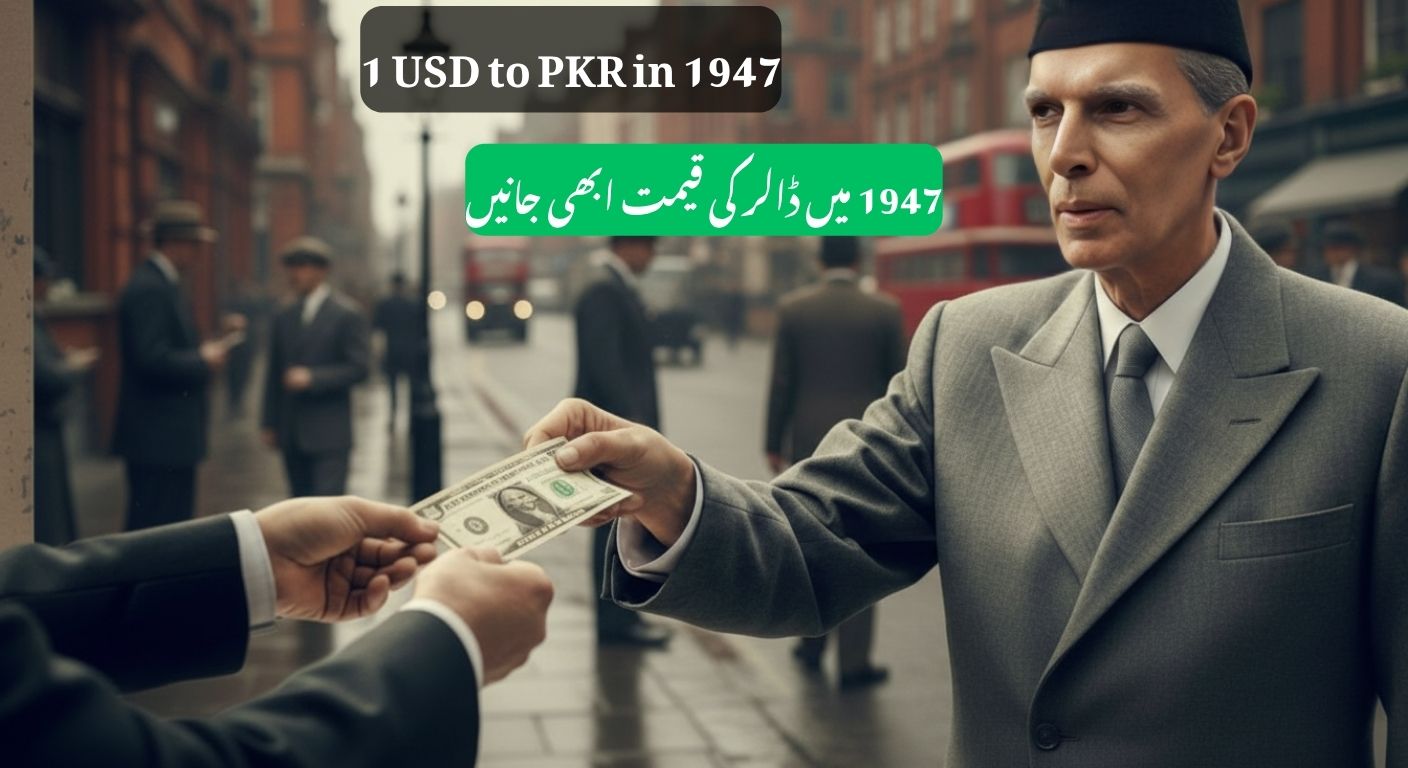
The value of the US dollar against the Pakistani rupee has seen a long and dramatic journey since Pakistan’s independence. Back in 1947, 1 USD was equal to PKR 3.31. However, in 2025, the rate has climbed to around PKR 283.35. This huge difference shows how Pakistan’s economy, currency strength, and financial policies have transformed over the years.
The Early Years (1947–1955): A Stable Start
When Pakistan came into being in 1947, its economy was stable, and there was no major debt burden. The Pakistani rupee was linked with the British pound, which gave it stability and value. Most of the trade during this time was done in rupees and pounds, while the US dollar was mainly used for foreign trade and aid.
In 1955, Pakistan devalued its currency for the first time to encourage exports and balance trade. The exchange rate then moved from PKR 3.31 to PKR 4.76 per USD, marking the country’s first major economic adjustment.
Key Turning Points in the USD to PKR Exchange Rate
| Year | USD to PKR | Key Event |
|---|---|---|
| 1947 | 3.31 | Independence; rupee linked to the British pound |
| 1955 | 4.76 | First devaluation to support exports |
| 1972 | 9.90 | Rupee floated after the separation of East Pakistan |
| 1982 | 12.85 | Managed float system introduced |
| 1990 | 21.71 | Economic reforms and liberalization |
| 2000 | 51.90 | Political instability and sanctions |
| 2008 | 70.65 | Global financial crisis impact |
| 2020 | 160.10 | COVID-19 pandemic pressure |
| 2025 | 283.35 | Current exchange rate |
The 1970s to 2000s: Decades of Change
The 1970s were a turning point for Pakistan’s economy. After the separation of East Pakistan in 1971, the rupee’s value declined rapidly. In 1972, Pakistan decided to float its currency, allowing the exchange rate to adjust based on market conditions.
In the 1980s, the government introduced a “managed float system,” giving limited flexibility to the rupee. However, the 1990s brought political instability and economic sanctions that caused further depreciation. By the 2000s, global events such as the 9/11 aftermath and the 2008 financial crisis deeply affected Pakistan’s currency and economy.
The Modern Era (2010–2025): Struggles and Adjustments
Over the final decade, the Pakistani rupee has faced strong pressure because of high imports, inflation, and reliance on IMF loans. The COVID-19 pandemic added additional pressure, causing the exchange charge to fluctuate sharply.
Despite this, distant places remittances — which now attain nearly $30 billion yearly — have furnished some relief to the economy. In 2025, inflation stands at round eight.7%, and while the rupee shows slight balance as compared to 2023, predominant demanding situations like trade imbalance and worldwide monetary uncertainty remain.
Conclusion
From PKR 3.31 in 1947 to PKR 283.35 in 2025, the journey of the US dollar in Pakistan tells the story of economic transformation, political shifts, and international effects. This exchange is greater than just a upward thrust in numbers — it reflects Pakistan’s growth, struggles, and resilience over time. The change price records mirrors how the usa has developed from a strong, debt-loose starting to an economy constantly adapting to the demanding situations of the cutting-edge world.